
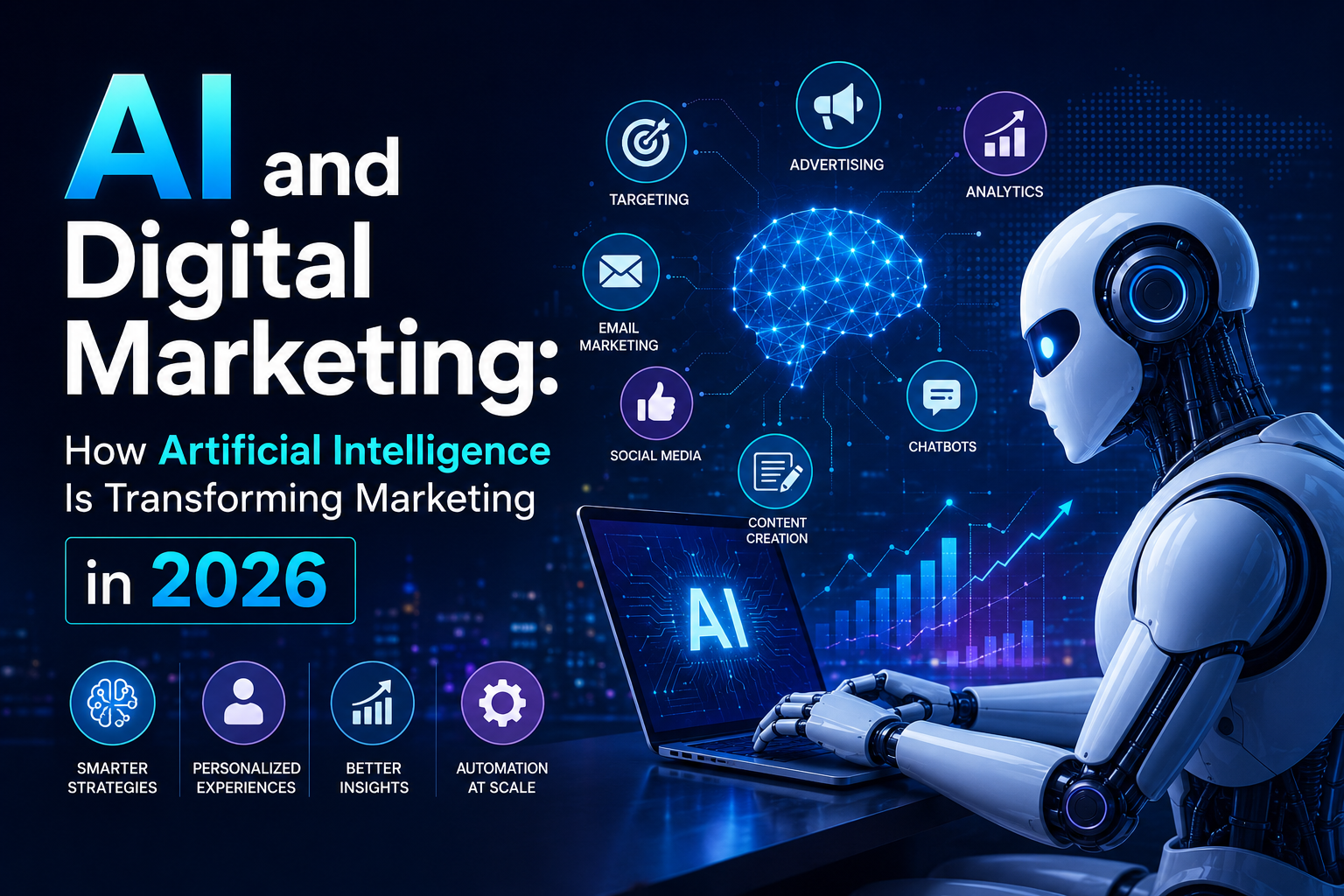
AI and Digital Marketing: How Artificial Intelligence Is Transforming Marketing in 2026
Artificial Intelligence (AI) has changed the way businesses approach digital marketing. From creating content and analyzing customer behavior to optimizing advertising campaigns and improving search engine visibility, AI is becoming an essential part of modern marketing. In the past, digital marketing depended heavily on manual research, repetitive tasks, traditional analytics, and guesswork. Today, marketers can use AI-powered tools to process huge amounts of data, understand customer intent, personalize campaigns, automate routine activities, and make faster marketing decisions. For small businesses, startups, e-commerce brands, agencies, and large organizations, understanding the relationship between AI and digital marketing is no longer optional. It is becoming an important competitive advantage. This guide explains how AI is transforming digital marketing, the benefits of AI marketing, practical applications, popular AI tools, SEO and content marketing strategies, paid advertising, social media automation, challenges, and the future of AI-powered marketing. What Is AI in Digital Marketing? AI in digital marketing refers to using artificial intelligence technologies to automate, analyze, predict, and improve different marketing activities. Marketers can use these capabilities to understand audiences, create content ideas, analyze campaigns, predict customer behavior, and personalize marketing experiences. AI does not necessarily replace marketers. Digital marketing has become highly competitive. Businesses are competing for attention across Google, social media, YouTube, email, websites, marketplaces, and other digital platforms. They want: AI can help businesses deliver these experiences at scale. One of the biggest advantages of AI is its ability to analyze data. A business may have thousands or millions of customer interactions, making manual analysis difficult. AI can analyze this information and help marketers identify: This allows marketing teams to move from simply asking, “What happened?” to asking, “Why did it happen?” and “What is likely to happen next?” 1. AI-Powered Content Marketing Content marketing is one of the areas where AI has had a major impact. Creating high-quality content requires research, planning, writing, editing, optimization, publishing, and promotion. AI can assist with many parts of this process. Marketers can use AI to generate: Example Suppose a digital marketing agency wants to publish an article about local SEO. This combination of AI efficiency and human expertise can produce stronger content. 2. AI and SEO SEO professionals traditionally spend significant amounts of time on: “digital marketing” The important point is that marketers should not blindly target every keyword suggested by AI. They need to evaluate: AI for Search Inten “What is SEO?” is primarily informational. “Best SEO agency in Mumbai” has commercial intent. “Buy running shoes online” has transactional intent. 3. AI for Content Optimization AI can analyze existing content and identify potential improvements. Modern SEO should focus on satisfying users. 4. AI-Powered Social Media Marketing Social media marketing requires consistent content. Businesses need to publish posts, reels, stories, videos, carousels, and promotional content regularly. AI can help social media marketers with: AI and Social Media Personalization It can help determine: 5. AI in Google Ads and Paid Advertising optimize bids, distribute budgets, and determine which combinations of creative and targeting are more likely to generate resu “Shop Stylish Casual Shirts” “Upgrade Your Everyday Style” “Premium Shirts at Great Prices” Automation does not mean marketers can simply launch campaigns and walk away. 6. AI Chatbots and Customer Support AI chatbots are increasingly being used by businesses to provide immediate customer assistance. A chatbot can answer common questions about: This can reduce the workload on customer support teams. “Where is my order Benefits of AI Chatbots AI chatbots can provide: 7. AI and Email Marketing Email marketing remains an important digital marketing channel. AI can make email marketing more personalized. AI can help with: This can create a more relevant customer experience. 8. AI-Powered Customer Segmentation Customer segmentation means dividing an audience into groups based on characteristics or behavior. Traditional segmentation might use: AI can go much deeper by analyzing behavioral patterns. This can improve personalization and potentially increase conversion rates. 9. Predictive Analytics in Digital Marketing One of the most powerful applications of AI is predictive analytics. Predictive analytics uses historical data and machine learning to identify patterns and estimate future outcomes. In marketing, businesses can use predictive models to estimate: This moves marketing from reactive decision-making toward proactive marketing. 10. AI for E-Commerce Marketing Online stores generate large amounts of behavioral data. AI can analyze: This information can be used for personalized recommendations. A customer purchases running shoes. An AI recommendation system may suggest: This can increase cross-selling and upselling opportunities. 11. AI-Powered Product Recommendations Product recommendations are one of the most visible applications of AI in e-commerce. AI systems can compare a customer’s behavior with patterns from similar customers. This can create a personalized shopping experience. 12. AI for Marketing Analytics Marketing generates enormous amounts of data. AI can help analyze: 13. AI and Voice Search “Best restaurant Mumbai” a user might ask: “What are some good restaurants near me for a family dinner?” This means marketers need to consider conversational search behavior. FAQ sections, conversational content, local information, and clear answers can become important parts of a modern search strategy. 14. AI and Local SEO AI can assist with: 15. AI for Video Marketing AI can support video production by helping marketers create: A marketer can turn one long-form article into multiple pieces of video content. One blog post about SEO can become: This process is known as content repurposing, and AI can make it much faster. 16. AI for Marketing Automation Marketing automation involves using technology to automate repetitive marketing activities. AI can make automation more intelligent. Examples include: 17. AI and Lead Generation Generating qualified leads is a major goal for many businesses. AI can help identify potential customers by analyzing: AI-powered lead scoring can rank leads based on their likelihood of converting. This can save time and improve sales efficiency. 18. AI for Personalization Personalization is one of the biggest advantages of AI-powered marketing. Traditional marketing often sends the same message to a large audience. AI allows marketers to create more individualized experiences. Personalization can include:
AI and Digital Marketing: How Artificial Intelligence Is Transforming Marketing in 2026 Read More »