
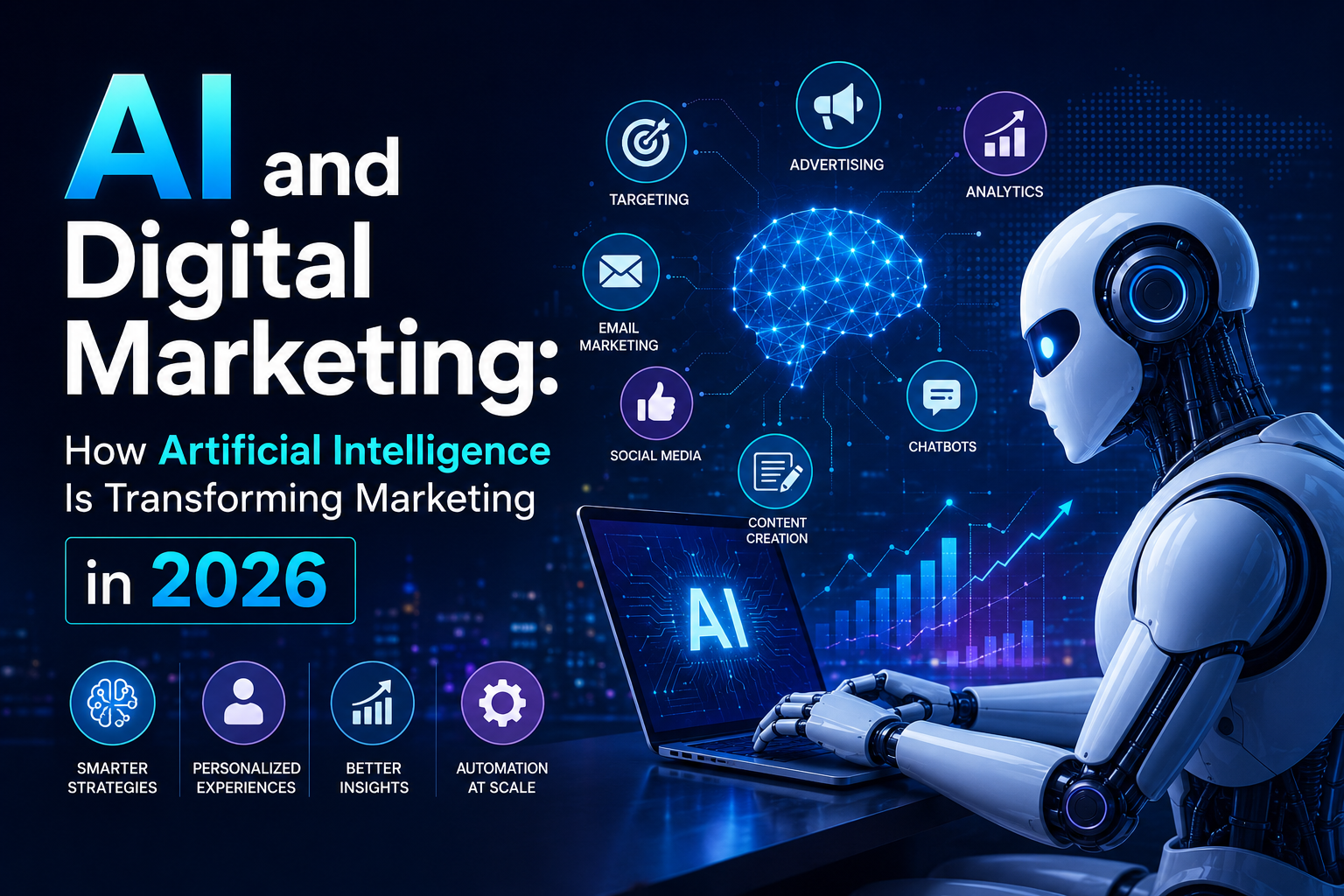
Artificial Intelligence (AI) has changed the way businesses approach digital marketing. From creating content and analyzing customer behavior to optimizing advertising campaigns and improving search engine visibility, AI is becoming an essential part of modern marketing.
In the past, digital marketing depended heavily on manual research, repetitive tasks, traditional analytics, and guesswork. Today, marketers can use AI-powered tools to process huge amounts of data, understand customer intent, personalize campaigns, automate routine activities, and make faster marketing decisions.
For small businesses, startups, e-commerce brands, agencies, and large organizations, understanding the relationship between AI and digital marketing is no longer optional. It is becoming an important competitive advantage.
This guide explains how AI is transforming digital marketing, the benefits of AI marketing, practical applications, popular AI tools, SEO and content marketing strategies, paid advertising, social media automation, challenges, and the future of AI-powered marketing.
What Is AI in Digital Marketing?
AI in digital marketing refers to using artificial intelligence technologies to automate, analyze, predict, and improve different marketing activities.
Marketers can use these capabilities to understand audiences, create content ideas, analyze campaigns, predict customer behavior, and personalize marketing experiences.
AI does not necessarily replace marketers.
Digital marketing has become highly competitive. Businesses are competing for attention across Google, social media, YouTube, email, websites, marketplaces, and other digital platforms.
They want:
- Relevant content
- Fast responses
- Personalized recommendations
- Helpful information
- Convenient shopping experiences
- Quick customer support
- Consistent communication
AI can help businesses deliver these experiences at scale.
One of the biggest advantages of AI is its ability to analyze data. A business may have thousands or millions of customer interactions, making manual analysis difficult.
AI can analyze this information and help marketers identify:
- Customer preferences
- Buying patterns
- Popular products
- Audience segments
- Campaign performance
- Website behavior
- Content interests
- Potential customer churn
- Advertising opportunities
This allows marketing teams to move from simply asking, “What happened?” to asking, “Why did it happen?” and “What is likely to happen next?”
1. AI-Powered Content Marketing
Content marketing is one of the areas where AI has had a major impact.
Creating high-quality content requires research, planning, writing, editing, optimization, publishing, and promotion.
AI can assist with many parts of this process.
- Blog topic ideas
- Content briefs
- Headlines
- Meta descriptions
- Social media captions
- Email subject lines
- Video scripts
- Product descriptions
- FAQs
- Content outlines
- Ad copy
Marketers can use AI to generate:
- Original insights
- Accurate information
- Brand personality
- Experience
- Examples
- Human editing
- Fact-checking
- Audience understanding
Example
Suppose a digital marketing agency wants to publish an article about local SEO.
- Target audience
- Search intent
- Topic clusters
- Potential headings
- FAQs
- Content structure
This combination of AI efficiency and human expertise can produce stronger content.
2. AI and SEO
SEO professionals traditionally spend significant amounts of time on:
- Keyword research
- Competitor analysis
- Search intent analysis
- Content planning
- Technical audits
- Internal linking
- Content optimization
- Performance analysis
“digital marketing”
- Digital marketing services
- Digital marketing agency
- Digital marketing course
- Digital marketing consultant
- Digital marketing strategies
- Digital marketing for small businesses
- AI in digital marketing
- Digital marketing trends
The important point is that marketers should not blindly target every keyword suggested by AI.
They need to evaluate:
- Search intent
- Relevance
- Competition
- Business value
- Search volume
- Conversion potential
AI for Search Inten
“What is SEO?”
is primarily informational.
“Best SEO agency in Mumbai”
has commercial intent.
“Buy running shoes online”
has transactional intent.
3. AI for Content Optimization
AI can analyze existing content and identify potential improvements.
- Missing subtopics
- Repetitive sections
- Weak headings
- Content gaps
- Poor readability
- Frequently asked questions
- Opportunities for internal links
Modern SEO should focus on satisfying users.
4. AI-Powered Social Media Marketing
Social media marketing requires consistent content.
Businesses need to publish posts, reels, stories, videos, carousels, and promotional content regularly.
AI can help social media marketers with:
- Content ideas
- Captions
- Hashtags
- Video scripts
- Content calendars
- Audience research
- Post variations
- Creative concepts
- Performance analysis
- Food photography ideas
- Customer testimonials
- Behind-the-scenes content
- Promotional offers
- Reels
- Educational posts
- Festival-related posts
- User-generated content ideas
AI and Social Media Personalization
It can help determine:
- Which posts generate the most engagement
- Which topics attract followers
- Which content drives website traffic
- What time audiences are active
- Which audience segments respond to specific content
5. AI in Google Ads and Paid Advertising
optimize bids, distribute budgets, and determine which combinations of creative and targeting are more likely to generate resu
- Headlines
- Descriptions
- Ad copy
- Calls to action
- Creative concepts
“Shop Stylish Casual Shirts”
“Upgrade Your Everyday Style”
“Premium Shirts at Great Prices”
Automation does not mean marketers can simply launch campaigns and walk away.
- Business objectives
- Target customers
- Product positioning
- Profit margins
- Conversion tracking
- Landing pages
- Creative quality
- Customer journey
6. AI Chatbots and Customer Support
AI chatbots are increasingly being used by businesses to provide immediate customer assistance.
A chatbot can answer common questions about:
- Products
- Pricing
- Delivery
- Returns
- Services
- Appointments
- Business hours
- Order status
- Frequently asked questions
This can reduce the workload on customer support teams.
“Where is my order
Benefits of AI Chatbots
AI chatbots can provide:
- 24/7 support
- Faster responses
- Scalable customer service
- Reduced repetitive work
- Consistent answers
- Lead qualification
7. AI and Email Marketing
Email marketing remains an important digital marketing channel.
AI can make email marketing more personalized.
AI can help with:
- Subject lines
- Email copy
- Personalization
- Audience segmentation
- Send-time optimization
- Product recommendations
- Campaign analysis
This can create a more relevant customer experience.
8. AI-Powered Customer Segmentation
Customer segmentation means dividing an audience into groups based on characteristics or behavior.
Traditional segmentation might use:
- Age
- Gender
- Location
- Income
- Occupation
AI can go much deeper by analyzing behavioral patterns.
- Visit the website frequently
- Add products to their cart
- Rarely complete purchases
- Frequently purchase premium products
- Respond strongly to discounts
- Have not purchased recently
This can improve personalization and potentially increase conversion rates.
9. Predictive Analytics in Digital Marketing
One of the most powerful applications of AI is predictive analytics.
Predictive analytics uses historical data and machine learning to identify patterns and estimate future outcomes.
In marketing, businesses can use predictive models to estimate:
- Which customers may purchase
- Which leads are most valuable
- Which products may become popular
- Which customers may stop purchasing
- Which campaigns may perform well
This moves marketing from reactive decision-making toward proactive marketing.
10. AI for E-Commerce Marketing
Online stores generate large amounts of behavioral data.
AI can analyze:
- Product views
- Purchases
- Cart activity
- Search behavior
- Customer reviews
- Purchase frequency
- Product preferences
This information can be used for personalized recommendations.
A customer purchases running shoes.
An AI recommendation system may suggest:
- Running socks
- Sports clothing
- Insoles
- Fitness accessories
This can increase cross-selling and upselling opportunities.
11. AI-Powered Product Recommendations
Product recommendations are one of the most visible applications of AI in e-commerce.
AI systems can compare a customer’s behavior with patterns from similar customers.
This can create a personalized shopping experience.
- Fashion
- Electronics
- Beauty
- Grocery
- Books
- Home products
- Subscription services
12. AI for Marketing Analytics
Marketing generates enormous amounts of data.
AI can help analyze:
- Website traffic
- Conversion rates
- Cost per lead
- Customer acquisition cost
- Return on advertising spend
- Engagement rates
- Email performance
- Sales trends
13. AI and Voice Search
“Best restaurant Mumbai”
a user might ask:
“What are some good restaurants near me for a family dinner?”
This means marketers need to consider conversational search behavior.
- What?
- Why?
- How?
- Where?
- Which?
FAQ sections, conversational content, local information, and clear answers can become important parts of a modern search strategy.
14. AI and Local SEO
AI can assist with:
- Local keyword research
- Content ideas
- Review response drafts
- Google Business Profile content
- Local landing pages
- Competitor analysis
- Customer sentiment analysis
- Digital marketing services in Mumbai
- SEO services for Mumbai businesses
- Best digital marketing strategies for local businesses
- Social media marketing for Mumbai brands
15. AI for Video Marketing
AI can support video production by helping marketers create:
- Scripts
- Storyboards
- Video concepts
- Captions
- Transcriptions
- Short-form video ideas
- Titles
- Descriptions
A marketer can turn one long-form article into multiple pieces of video content.
One blog post about SEO can become:
- One YouTube video
- Three Instagram Reels
- Five LinkedIn posts
- One carousel
- Several short videos
- An email newsletter
This process is known as content repurposing, and AI can make it much faster.
16. AI for Marketing Automation
Marketing automation involves using technology to automate repetitive marketing activities.
AI can make automation more intelligent.
Examples include:
- Welcome emails
- Lead nurturing
- Customer segmentation
- Retargeting
- Product recommendations
- Abandoned cart reminders
- Chatbot responses
- Follow-up messages
17. AI and Lead Generation
Generating qualified leads is a major goal for many businesses.
AI can help identify potential customers by analyzing:
- Website behavior
- Form submissions
- Previous interactions
- Demographics
- Engagement
- Purchase history
AI-powered lead scoring can rank leads based on their likelihood of converting.
This can save time and improve sales efficiency.
18. AI for Personalization
Personalization is one of the biggest advantages of AI-powered marketing.
Traditional marketing often sends the same message to a large audience.
AI allows marketers to create more individualized experiences.
Personalization can include:
- Personalized emails
- Product recommendations
- Website experiences
- Advertisements
- Content suggestions
- Offers
- Notifications
The more relevant the experience, the more likely the customer may engage with the business.
19. AI Tools for Digital Marketers
There are many AI-powered tools available to marketers.
The right tool depends on the task.
Common categories include:
AI Writing Tools
Useful for:
- Content ideas
- Drafting
- Rewriting
- Summaries
- Headlines
- Scripts
SEO Tools
Useful for:
- Keyword research
- Competitor analysis
- Content optimization
- Site audits
- Rank tracking
Design Tools
Useful for:
- Social media graphics
- Presentations
- Advertisements
- Thumbnails
- Marketing creatives
Video Tools
Useful for:
- Video editing
- Captions
- Transcription
- Script development
- Short-form video creation
Analytics Tools
Useful for:
- Customer behavior
- Website analytics
- Campaign analysis
- Reporting
- Predictive insights
The key is not to use the maximum number
20. Benefits of AI in Digital Marketing
AI provides several important advantages.
Faster Content Creation
AI can help marketers generate first drafts and ideas quickly.
Improved Personalization
Businesses can deliver more relevant content and recommendations.
Marketing Automation
Repetitive activities can be automated.
Better Customer Experience
Chatbots and recommendation systems can provide faster and more relevant assistance.
Improved Decision-Making
AI can identify patterns that may be difficult to discover manually.
Increased Productivity
Marketers can spend less time on repetitive work and more time on strategic activities.
Scalability
AI allows businesses to manage larger volumes of marketing activity without increasing manual workload at the same rate.
21. Challenges of Using AI in Digital Marketing
1. Lack of Originality
AI-generated content can sometimes sound generic.
Human creativity and experience remain important.
2. Accuracy Problems
AI systems can sometimes produce incorrect information.
3. Privacy Concerns
Businesses need to handle customer data responsibly.
4. Over-Automation
Automating everything can make a brand feel impersonal.
5. Brand Voice
AI-generated content may not automatically match a company’s personality.
Human editing is often necessary.
22. AI vs Human Marketers
A common question is:
Will AI replace digital marketers?
AI is excellent at:
- Data processing
- Pattern recognition
- Automation
- Repetitive tasks
- Content variations
- Analysis
- Creativity
- Strategy
- Empathy
- Leadership
- Brand positioning
- Relationship building
- Critical thinking
- Understanding complex business situations
The future is likely to belong to marketers who know how to work effectively with AI.
23. How Small Businesses Can Use AI
- Research content topics.
- Create social media ideas.
- Draft advertisements.
- Respond to common customer questions.
- Analyze customer feedback.
- Create email campaigns.
- Develop SEO content.
- Generate marketing reports.
- Improve customer segmentation.
- Automate follow-ups.
24. How to Create an AI-Powered Digital Marketing Strategy
Businesses can follow a simple process.
Step 1: Define Your Goal
Determine what you want to achieve.
Examples:
- Increase website traffic
- Generate leads
- Increase sales
- Improve retention
- Grow social media
- Reduce marketing costs
Step 2: Understand Your Audience
Identify:
- Who they are
- What they need
- What problems they have
- What motivates them
- Where they spend time online
Step 3: Identify Repetitive Tasks
Find marketing activities that consume significant time.
These could include:
- Reporting
- Content research
- Email segmentation
- Customer support
- Social media planning
Step 4: Choose Appropriate AI Tools
Select tools based on actual business needs.
- Traffic
- Leads
- Sales
- Conversion rate
- Customer acquisition cost
- Return on advertising spend
- Engagement
AI marketing should be treated as an ongoing optimization process.
25. The Future of AI and Digital Marketing
The future of digital marketing will likely become increasingly AI-driven.
We can expect AI to influence:
- Search
- Advertising
- Content creation
- Customer service
- Personalization
- Analytics
- E-commerce
- Video marketing
- Marketing automation
Search behavior itself is changing as people increasingly interact with conversational AI systems.
This means marketers will need to think beyond traditional keyword rankings.
They will need to focus on:
- Brand authority
- Original content
- Trust
- Expertise
- Customer experience
- Structured information
- Multichannel visibility
Businesses that adapt early may have an advantage over those that continue relying entirely on traditional marketing methods.
26. AI Will Make Marketers More Strategic
- Strategy
- Research
- Creative direction
- Campaign planning
- Customer insights
- Brand building
- Business growth
27. Best Practices for AI-Powered Marketing
Businesses should follow several best practices.
Use AI With a Clear Objective
Start with a specific problem.
Review AI Output
Always review important AI-generated content.
Protect Customer Data
Avoid exposing sensitive customer information to inappropriate tools or systems.
Maintain Brand Voice
Train teams and tools around your brand’s tone, messaging, and values.
Combine Data With Creativity
Test and Optimize
Experiment with different content, campaigns, and strategies.
Keep Humans in the Loop
28. Is AI Good for Digital Marketing?
It can help marketers:
- Work faster
- Understand customers
- Automate repetitive activities
- Improve personalization
- Analyze data
- Generate ideas
- Optimize campaigns
- Improve customer support
- A strong product or service
- Clear positioning
- A defined target audience
- Good marketing strategy
- Quality content
- Effective communication
- Consist
Conclusion
AI and digital marketing are becoming increasingly connected.
Artificial intelligence is changing how marketers research audiences, create content, optimize SEO, manage social media, run advertisements, analyze data, personalize customer experiences, and automate marketing activities.
The biggest opportunity is not simply using AI to produce more content. It is using AI to make marketing smarter, faster, more personalized, and more data-driven.
Businesses that learn how to combine AI technology with human creativity, strategic thinking, and genuine customer understanding will be better positioned for the future.
It is becoming an important part of the modern digital marketing ecosystem.
As technology continues to evolve, successful marketing will not be about choosing between humans and AI. It will be about combining the strengths of both.
Frequently Asked Questions About AI and Digital Marketing
What is AI in digital marketing?
AI in digital marketing means using artificial intelligence technologies to automate marketing tasks, analyze data, understand customer behavior, personalize experiences, create content, and optimize campaigns.
How is AI changing digital marketing?
Can AI replace digital marketers?
. Human strategy, creativity, critical thinking, empathy, and business understanding remain highly valuable.
How can AI help with SEO?
AI can assist with keyword research, search-intent analysis, content planning, competitor research, content optimization, internal-linking ideas, and SEO analysis.
Can small businesses use AI marketing?
Yes. Small businesses can use AI for content creation, social media planning, customer support, email marketing, SEO research, advertising, analytics, and automation.
Is AI-generated content good for SEO?
What are the benefits of AI in marketing?
Major benefits include automation, productivity, personalization, faster analysis, improved customer experiences, scalable marketing, and data-driven decision-making.
What are the disadvantages of AI in digital marketing?
Potential challenges include inaccurate information, generic content, privacy concerns, over-automation, lack of originality, and excessive dependence on technology.
What is the future of AI in digital marketing?
AI is likely to become increasingly integrated into SEO, advertising, content creation, analytics, personalization, e-commerce, social media, and customer service. Marketers will increasingly need AI skills alongside traditional marketing expertise.